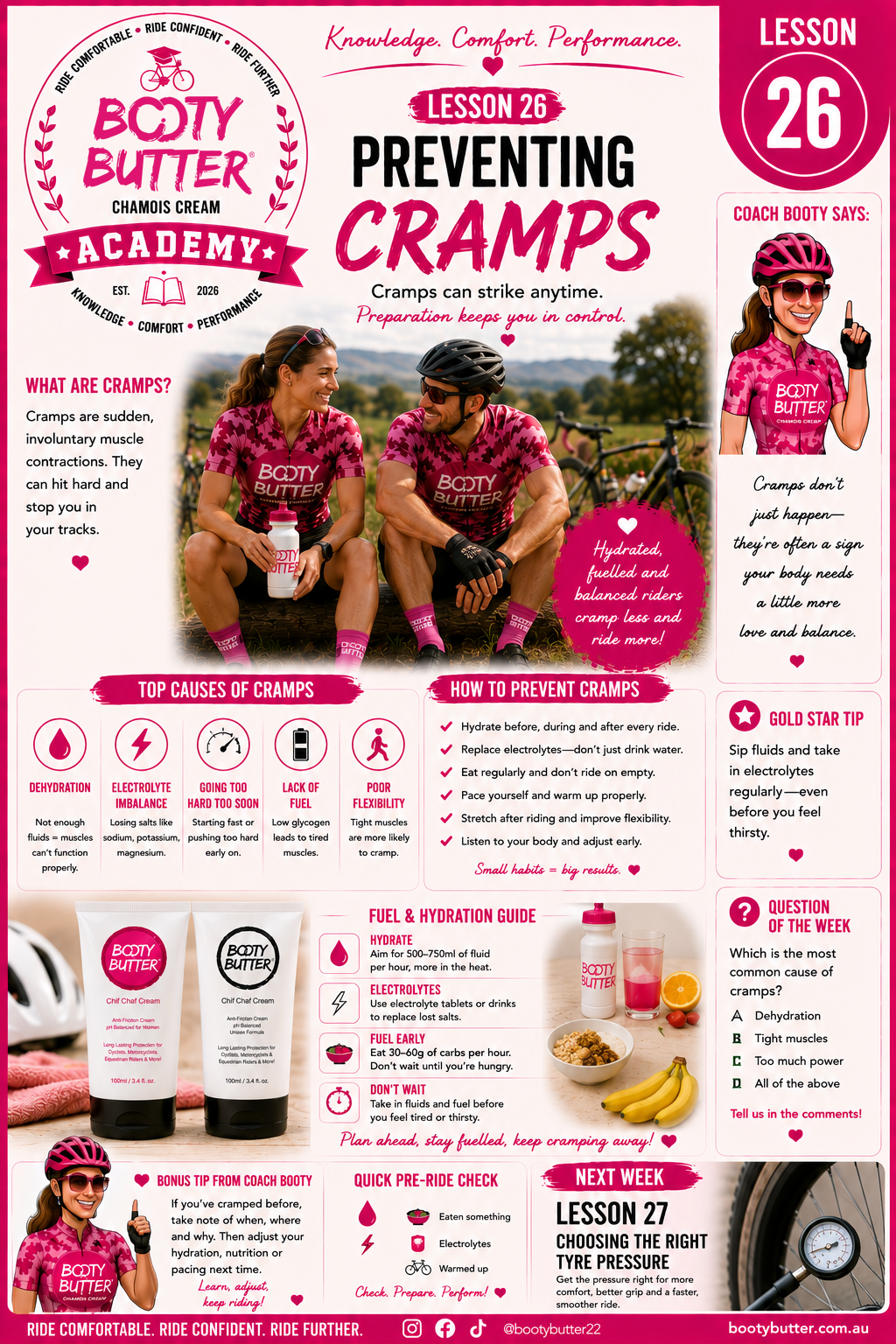
Lesson 26 - Preventing Cramps
🎓 BOOTY BUTTER ACADEMY | LESSON 26 Preventing Cramps
Keep your legs working when the kilometres start adding up.
Few things can ruin a great ride faster than a sudden, painful muscle cramp. You're riding along feeling good and then—bang! Your calf, hamstring or thigh suddenly tightens and refuses to cooperate.
Few things can ruin a great ride faster than a sudden, painful muscle cramp. You're riding along feeling good and then—bang! Your calf, hamstring or thigh suddenly tightens and refuses to cooperate.
The good news? There are several things you can do to reduce the likelihood of cramps and help your body handle longer rides. Let's look at how to keep those legs happy.
💧 1. Start Your Ride Hydrated
Don't wait until you're already thirsty or cramping to think about fluids. Before a longer ride, make sure you're adequately hydrated and take fluids with you.
💧 1. Start Your Ride Hydrated
Don't wait until you're already thirsty or cramping to think about fluids. Before a longer ride, make sure you're adequately hydrated and take fluids with you.
During the ride:
✔ Drink regularly rather than waiting until you're extremely thirsty.
✔ Increase your fluid intake when conditions are hot.
✔ Carry enough water for the distance and available refill points.
✔ Increase your fluid intake when conditions are hot.
✔ Carry enough water for the distance and available refill points.
Remember: Hydration is important, but cramps aren't caused by dehydration alone. Fatigue, muscle load, pacing and individual factors can all play a role.
🧂 2. Think About Electrolytes
When you sweat, you lose water and electrolytes, including sodium. For shorter, easier rides, your normal food and fluid intake may be enough.
🧂 2. Think About Electrolytes
When you sweat, you lose water and electrolytes, including sodium. For shorter, easier rides, your normal food and fluid intake may be enough.
But during longer or particularly hot rides, replacing electrolytes can become more important.
Consider:
✔ An electrolyte drink.
✔ Electrolyte products appropriate for your needs.
✔ Foods containing sodium during longer rides.
✔ Electrolyte products appropriate for your needs.
✔ Foods containing sodium during longer rides.
Don't wait until you're struggling before thinking about your nutrition and hydration plan.
🍌 3. Fuel Your Ride
Your muscles need energy to keep working. Starting a long ride without enough food—or waiting too long before eating—can leave you feeling exhausted.
🍌 3. Fuel Your Ride
Your muscles need energy to keep working. Starting a long ride without enough food—or waiting too long before eating—can leave you feeling exhausted.
For longer rides:
✔ Start well fuelled.
✔ Begin eating before you're completely hungry.
✔ Eat regularly throughout the ride.
✔ Choose foods and drinks you've practised with before.
✔ Begin eating before you're completely hungry.
✔ Eat regularly throughout the ride.
✔ Choose foods and drinks you've practised with before.
A little planning can make a huge difference when the kilometres start adding up.
🚴 4. Don't Start Too Hard
This is one of the biggest mistakes riders make. You feel fantastic for the first 20 kilometres, so you push the pace.
🚴 4. Don't Start Too Hard
This is one of the biggest mistakes riders make. You feel fantastic for the first 20 kilometres, so you push the pace.
Then the fatigue catches up. Muscle fatigue can contribute to cramping, so try to manage your effort—especially early in a long ride.
Start controlled. Build gradually. Save something for later.
🔄 5. Find a Comfortable Cadence
Grinding a very hard gear can place a lot of load on your muscles. Instead, aim for a cadence that feels smooth and sustainable.
🔄 5. Find a Comfortable Cadence
Grinding a very hard gear can place a lot of load on your muscles. Instead, aim for a cadence that feels smooth and sustainable.
If your legs are constantly pushing against a heavy gear: ➡️ Shift down. A slightly easier gear can help you maintain a smoother pedal stroke and manage muscular fatigue.
⛰️ 6. Be Careful on Hills
Climbing puts extra demand on your legs. Rather than attacking every hill:
⛰️ 6. Be Careful on Hills
Climbing puts extra demand on your legs. Rather than attacking every hill:
✔ Choose an appropriate gear.
✔ Maintain a manageable effort.
✔ Stay seated when that feels more sustainable.
✔ Stand briefly when useful.
✔ Avoid turning every climb into a race.
✔ Maintain a manageable effort.
✔ Stay seated when that feels more sustainable.
✔ Stand briefly when useful.
✔ Avoid turning every climb into a race.
Remember—the goal is to get over the hill, not win the hill.
🧘 7. Listen to Early Warning Signs
Sometimes your body gives you a warning before a full cramp arrives.
🧘 7. Listen to Early Warning Signs
Sometimes your body gives you a warning before a full cramp arrives.
You may notice:
🛑 8. What If You Actually Get a Cramp?
If a significant cramp occurs, don't try to power through it. Safely slow down or stop.
- Muscle twitching.
- Tightness.
- A sudden change in your pedal stroke.
- A feeling that a muscle is becoming unusually fatigued.
🛑 8. What If You Actually Get a Cramp?
If a significant cramp occurs, don't try to power through it. Safely slow down or stop.
Gently stretch the affected muscle and allow it to relax. Once the cramp settles, ease back into riding rather than immediately returning to maximum effort.
If cramps are frequent, severe, prolonged or occurring outside exercise, it's worth discussing them with an appropriate healthcare professional.
💗 Bonus Tip – Comfort Matters
When you're uncomfortable on the bike, your body can become tense and your riding position can change. That can make an already-fatiguing ride feel even harder.
💗 Bonus Tip – Comfort Matters
When you're uncomfortable on the bike, your body can become tense and your riding position can change. That can make an already-fatiguing ride feel even harder.
Before every ride, apply Booty Butter Chamois Cream to help reduce friction and keep you comfortable from the first kilometre to the last.
Because when you're comfortable, you can focus on riding—not what's happening in the saddle.
🎯 This Week's Challenge
On your next longer ride, practise cramp prevention rather than waiting for a problem.
🎯 This Week's Challenge
On your next longer ride, practise cramp prevention rather than waiting for a problem.
Before you leave:
✔ Start hydrated.
✔ Pack enough fluids.
✔ Plan your nutrition.
✔ Check the weather and temperature.
✔ Choose a sensible pace.
✔ Pack enough fluids.
✔ Plan your nutrition.
✔ Check the weather and temperature.
✔ Choose a sensible pace.
During your ride:
✔ Drink regularly.
✔ Eat before you're starving.
✔ Keep your cadence comfortable.
✔ Ease off if your legs begin to fatigue.
✔ Eat before you're starving.
✔ Keep your cadence comfortable.
✔ Ease off if your legs begin to fatigue.
See how much better your legs feel when you manage the ride before they start complaining!
💡 Coach Booty Says "Don't wait for your legs to tell you you've gone too far. Learn to listen before they start shouting."
⭐ Gold Star Tip - Practise your nutrition and hydration strategy before event day. Never wait until your first big cycling event to discover that a particular drink, gel or food doesn't agree with you.
Training isn't just about training your legs—it's about learning what works for your body.
❓ Question of the Week
What's your biggest challenge on a long ride?
💧 Staying hydrated
❓ Question of the Week
What's your biggest challenge on a long ride?
💧 Staying hydrated
🍌 Remembering to eat
⛰️ Climbing hills
🦵 Tired legs
😖 Muscle cramps
☕ Finding the next coffee stop!
🎓 Next Week at Booty Butter Academy...
Lesson 27 – Choosing the Right Tyre Pressure
Next week we'll discover why tyre pressure isn't simply a matter of pumping your tyres as hard as possible.
🎓 Next Week at Booty Butter Academy...
Lesson 27 – Choosing the Right Tyre Pressure
Next week we'll discover why tyre pressure isn't simply a matter of pumping your tyres as hard as possible.
We'll cover:
✔ How tyre pressure affects comfort and grip.
✔ Why rider weight matters.
✔ How tyre width changes the ideal pressure.
✔ Adjusting pressure for different riding surfaces.
✔ The difference between too much and too little pressure.
✔ How to find a pressure that works for you and your bike.
The right tyre pressure can make your bike feel completely different.
Ride Comfortable. Ride Confident. Ride Further. 💗